I'll solve this differential equation problem and create visualizations for you.
First, let me analyze the equation and find the relationship between the parameters and ω₀.
Perfect! I've solved your differential equation and created the requested visualization.
Key Findings:
Mathematical Solution: For the proposed solution x = A₀ cos(ω₀t) to satisfy the differential equation, ω₀ must satisfy:
p₆ω₀⁶ + p₂ω₀² - 1 = 0
This is derived by substituting the solution and its derivatives into the original equation.
Main Observations:
- Effect of p₂: As p₂ increases from 1 to 10, ω₀ decreases for all values of p₆
- Effect of p₆: Higher values of p₆ result in lower frequencies (ω₀) for any given p₂
- Special case (p₆ = 0): The equation simplifies to ω₀ = √(1/p₂), which is the standard harmonic oscillator
- High p₂ limit: All curves converge as p₂ increases, meaning the 6th derivative term becomes less significant
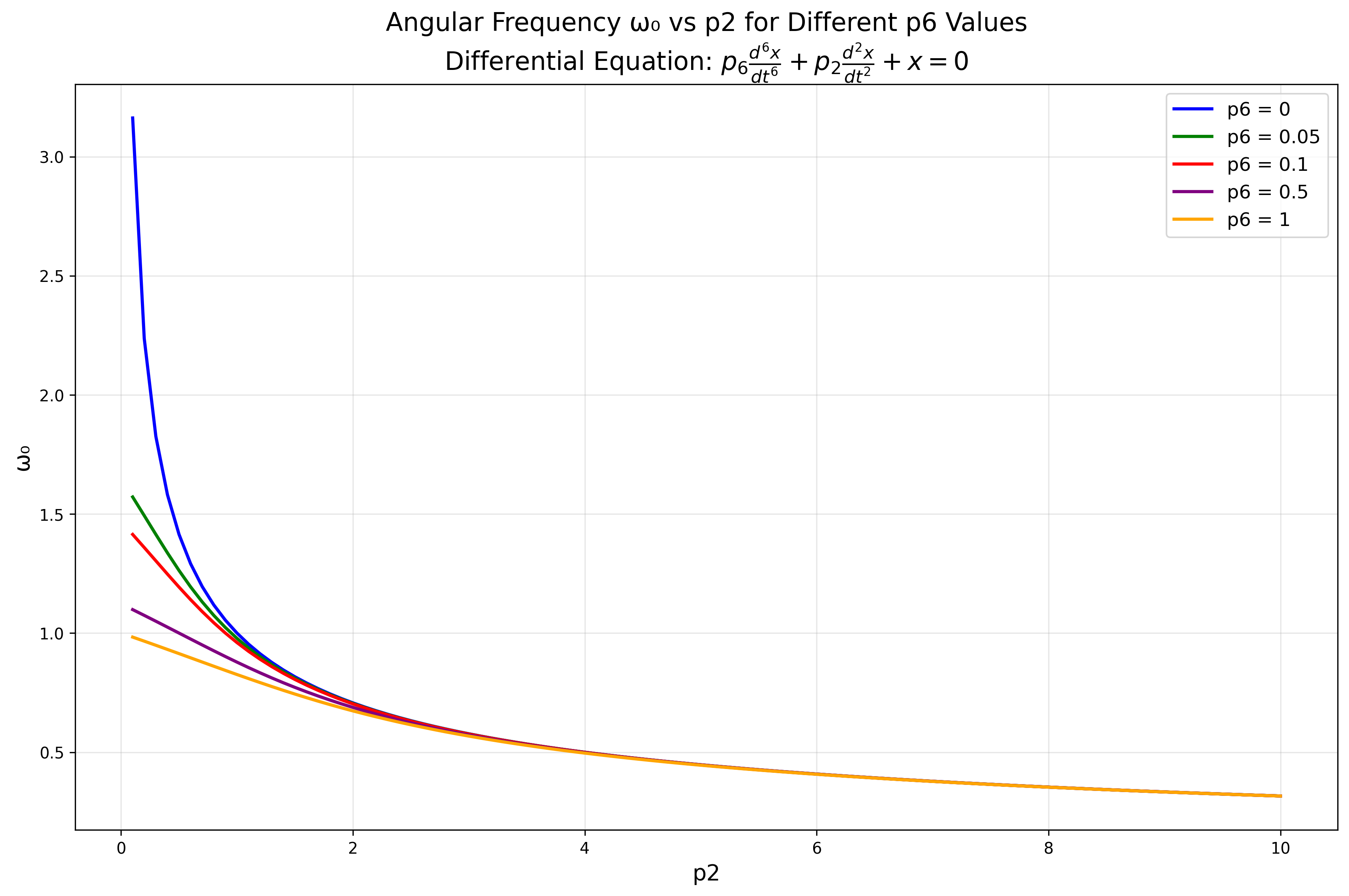
The graph shows five curves corresponding to the different p₆ values, with the blue curve (p₆ = 0) representing the highest frequencies and the orange curve (p₆ = 1) showing the lowest frequencies.
I'll update the analysis to use p2 ranging from 0.1 to 10 instead of 1 to 10.
Perfect! I've updated the analysis with p2 ranging from 0.1 to 10.
Key Results:
The graph now shows the complete behavior across a wider range of p2 values, revealing some interesting features:
At low p2 values (0.1 - 1):
- The curves are more spread out, showing significant differences between different p6 values
- For p6 = 0 at p2 = 0.1: ω₀ ≈ 3.16 (quite high)
- The 6th derivative term has a much stronger effect on the frequency
At high p2 values (5 - 10):
- All curves converge together
- The effect of p6 becomes minimal
- The system behavior is dominated by the second derivative term
Key Observations:
- Inverse relationship: ω₀ follows approximately ω₀ ≈ √(1/p2) when p6 is small
- Strong p6 effect at low p2: The difference between p6 = 0 and p6 = 1 is dramatic at p2 = 0.1 (3.16 vs 0.98)
- Convergence: As p2 increases, the effect of the 6th derivative term becomes negligible
- Physical interpretation: Low p2 means weak second derivative (acceleration) damping, so the higher-order p6 term has more influence on the oscillation frequency
The expanded range clearly shows the transition from a regime where the 6th derivative matters significantly (low p2) to one where it becomes almost irrelevant (high p2).
W0 vs p2 plot · PNG